What is so striking isn’t how we (the living) are making it, but how we’re not.
How the days pass, and the nights and all that can be said: I made it to the parking meter on time. I got to work, swept the floor again, made a few calls.
An old man came by the orchard today, his granddaughter, at least 30, brought him in, his back was bent the way some people’s do with age, so he could only see one thing at a time. She was good though, told him where he was headed loud enough so he could hear. There’s a ramp up into the store to get inside, and the first thing she said, I heard her say: “We’re going up hill now Grandpa, keep going, still uphill, we’re almost there.”
Once they reached the registers, she dropped him off.
He still was looking down; he hung his cane beside the honey on the counter, put both hands down across from mine, so that he held himself up. He looked up then, at me: “Where’d she go?”
“She’s by the cider.”
“This is no fun you know. My wife an I used to come here all the time. Do you still have apples? Apple pie?”
“Sure we do.”
“Good.” He said his granddaughter’s name, looking down “Get some apple pie.”
“I know, Grandpa. Cider first. I’m coming.” She came. “I got some for you.”
“Oh. Good.”
“You been here long?” He said, looking at me.
“Not too.” I said. And I too had been bent down towards the counter, not able to stand above him looking down.
He said, “My wife and I. I told you. We came here years ago. I haven’t come here for years. But today she brought me. It’s not so fun anymore you know, things not working like they used to.” And he was laughing — at himself — and made me laugh. It was proper — the laughter, the acknowledgment that neither of us (how could he know?) was what we used to be.
“Now where’d she go? I’m telling you. This is ridiculous.”
“She’s picking out the pie.”
“Get one for yourself.” He called out her name again, never really looking at anything but his hands, not really looking at all.
He had the face (of listening), of someone who is only listening, who must be still, be empty to concentrate, to hear the next thing said as if something rested on it; the outcome of each new word, as if he had to hear it, had to rest with the words as they were spoken, take them in and know them, and say what needed to be said. To be clear, lucid in answering.
We were talking about apples, about pie. Nothing important. How I wanted it to be, what kind of cider do we still have? Should they get a pumpkin, maybe, to bring home.
I wanted to make him laugh. To tell a good joke.
I wanted to tell him, (to be able to say) that I remembered how his wife used to pick out apples. Her hands were beautiful sifting through the bins. And how her hair would match the color of autumn. How the two of them came in, one behind the other, and how the place was better for it, how they teased each other about what the other wanted, what they could afford. I wanted to tell him — “I remember her. She was beautiful wasn’t she.”
But I hadn’t lived that long. All I could share —
“It’s not fun this way, no, when your body won’t do what you want it to. When you can’t carry the bags to the car or make it through the day without having to sit down, out of breath.”
“But I’m glad you came in. I’m glad you made it. I hope to see you again.”
“All right, we’re going. Does she have everything?”
“She does.”
“Good. Okay then. Thanks.”
“Yes, sir. Thank you.”
by Shannon Nissa Bailey Powers
October 20 , 2003.
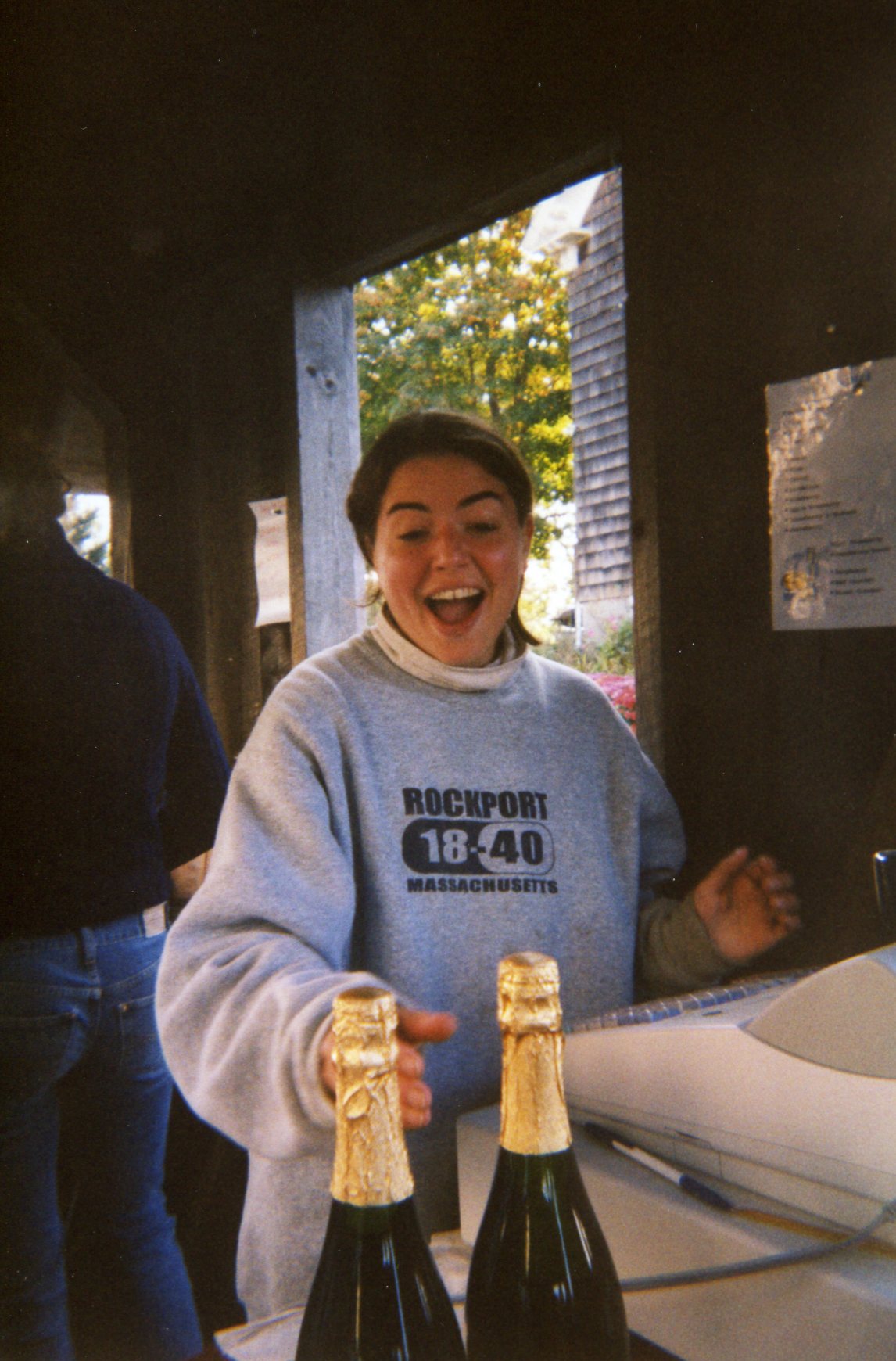
Shannon at Russell Orchards
 Shannon Nissa Bailey Powers